Cultural Restitution
SHARE ARTICLE
This week’s announcement that Cambridge University has transferred legal ownership of its collection of 116 Benin artefacts to Nigeria could be hugely significant.
It suggests the hesitation of some western collections that has prevented them from returning Benin artefacts before Nigerian stakeholders agree operational and exhibition responsibilities could be receding. Might this encourage others to do the same?
Nigeria’s National Commission for Museums and Monuments (NCMM) made their repatriation request to Cambridge’s Museum of Archaeology and Anthropology (MAA) in January 2022. Like other major UK and European museums, Cambridge’s collection was formed after the violent British sacking of Benin City in February 1897. Nigeria is keen to see the return of these much-valued looted artefacts.
The request was part of a wide-ranging engagement the Museum has had with the NCMM, state and federal governments, members of the Royal Court of the Oba (king) of Benin, and other Nigerian scholars and stakeholders over the last ten years. Their engagement has involved dialogue, research and liaison visits to Benin City.
“Over the period, support has mounted, nationally and internationally, for the repatriation of artefacts that were appropriated in the context of colonial violence,” explained Director of the MAA Professor Nicholas Thomas. “This return has been keenly supported across the University community.”
Securing the authorisations required to return the Museum’s 116 Benin artefacts took less than twelve months. The University’s Council supported Nigeria’s claim in July 2022 and the UK’s Charity Commission granted their permission in December the same year. But arrangements for the physical return of the artefacts have been stalled while political wrangling continued in Nigeria over who should manage the return, conservation, storage and exhibition of the artefacts. It's understandable why Cambridge, like other western institutions, decided to wait out this process until arrangements are finalised.
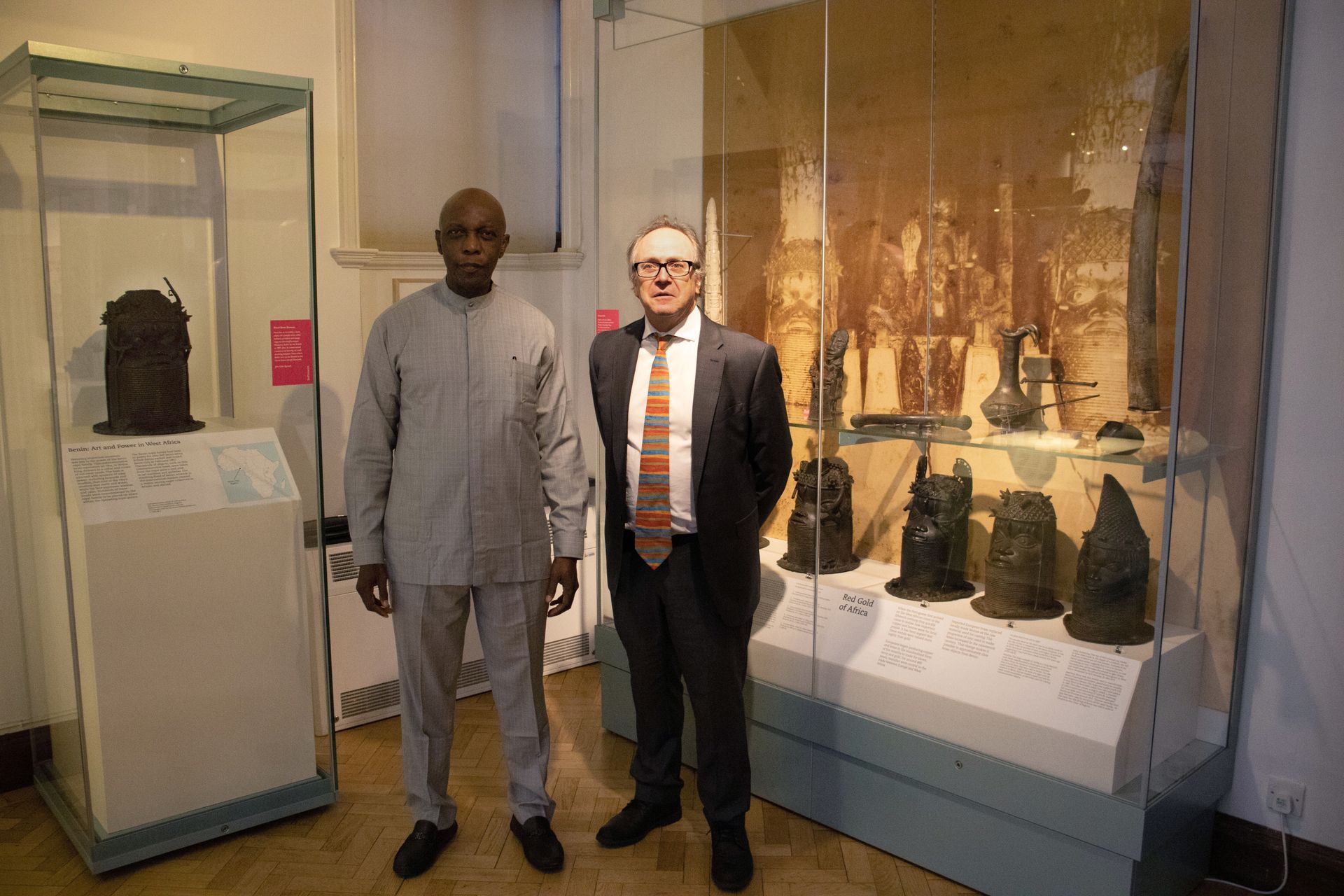
Prince Aghatise Erediauwa and Professor Nicholas Thomas, pictured at the MAA in 2021 as part of the Benin Dialogue Group Courtesy of the Museum of Archaeology and Anthropology
Operational responsibility for the return of the artefacts was finally settled in February last year when the Oba of Benin Ewuare II signed a management agreement for the NCMM to continue in this important role. But although an exhibition of returning Benin artefacts is currently taking place at the less than state-of-the-art Benin City National Museum, longer-term arrangements remain contentious.
As widely reported, the Oba has spoken of a desire to see his ancestors’ artefacts exhibited in a new (unfunded) Benin Royal Museum. At the same time, he has attacked the motives and aspirations (since watered down) to display these artefacts at the new Museum of West African Art (MOWAA), where many western institutions understood their Benin artefacts would be exhibited.
Opinions and tempers are still running high. This was all too apparent last November when protests erupted during an international preview of the recently completed MOWAA. Demonstrators at the event made it clear they wished to see the new museum placed under the direct control of the Oba. Some were calling for it to be renamed as the Benin Royal Museum.
We can’t help feeling within those protests may lie the seeds of a compromise. A permanent exhibition of Benin bronzes at the MOWAA would meet with approval of those western institutions who’ve not only engaged in a lengthy dialogue about exhibition opportunities at MOWAA but may also have made a financial contribution to its construction and resources. To these institutions at least, the politics between the different stakeholders are possibly less important than the security and standards of museum resources and facilities.
Why Cambridge has decided now to transfer legal title of their Benin artefacts to the NCMM, three years after they received authorisation, is therefore significant. Could it be they feel the time has arrived to relax their earlier hesitation? A statement from NCMM’s Director-General, Olugbile Holloway, makes it clear that both parties have arrived at “a pivotal point in our dialogue”. He adds, “it is our hope that this will spur other museums to head in a similar direction.”
According to the MAA, a formal handover ceremony is expected within months rather than years. In the meantime, in the same spirit of collaboration the NCMM has forged with other museums holding Benin artefacts, including the Horniman Museum and Gardens in London and the Smithsonian’s National Museum of African Art in Washington DC, a small number of Benin artefacts will be allowed to remain on loan at the MAA in Cambridge.
This is another sign of a growing confidence that continued dialogue can lead to opportunities for collaboration. It may also encourage others to consider transferring legal title of their Benin artefacts to Nigeria.
Photo: Commemorative Head of the Oba, or King, in brass
Courtesy of Fred Lewsey
More News