Cultural Restitution
SHARE ARTICLE
The USA is being urged not to renew a proposed extension to a five-year cultural property agreement with the Arab Republic of Egypt, on the grounds Egypt has prioritised ‘prestige megaprojects’ and ‘political spectacle’ over site protection and professional collections management.
The submission was made to members of the USA’s Cultural Property Advisory Committee (‘CPAC’) at a closed session that met on 3-5 March 2026. Members were advised that renewing the agreement would enable state control by Egypt over its heritage, restrict scholarship and cultural exchange, and penalise the lawful circulation of art. The existing Memorandum of Understanding (‘MOU’) remains in place until 30 November 2026.
U.S. import restrictions, defined under the Convention on Cultural Property Implementation Act (‘CPIA’), are designed to act as an effective, targeted, global anti-looting policy. But according to the submission made by Kate Fitz Gibbon, Executive Director of the Committee for Cultural Policy (‘CCP’), ‘Egypt has not shown the sustained, transparent, verifiable self-help measures the CPIA contemplates.’ Furthermore, it accuses Egypt of undermining the exchange of cultural property and knowledge, using “heritage” to justify control over scholarship and narrative, while at the same time failing to protect significant archaeological and religious sites from destruction or development.
The CCP’s submission is especially critical of a requirement that involves the USA imposing a permanent or near-permanent embargo on everything old originally sourced from Egypt, highlighting the practical problems U.S. Customs and law enforcement will face when sweeping restrictions encompass ‘virtually every object ever made over a vast timeline and territory touched by many civilizations.’
‘We provided documentation showing that Egypt historically issued export documentation that was incomplete or non-itemized, yet its government now asserts that virtually all objects outside the country are “stolen”.’
Committee for Cultural Policy
For the MOU to be extended, beyond November 2026, the CPIA requires sight of specific evidence that the factual conditions that justified the original agreement are still in place. This includes evidence that Egypt has taken meaningful “self-help” measures to protect its cultural patrimony, that import restrictions will help deter pillaging, that other less dramatic remedies are unavailable, and that the restrictions remain consistent with the wider global community’s interchange of cultural property for scientific, cultural and educational purposes.
Under the current agreement, Egypt committed to use its best efforts to preserve its wider cultural heritage, also to manage inventories of museum and storeroom collections. But the CCP submission identifies “systemic shortcomings”: neglect of excavation sites such as Heliopolis, reportedly converted into a rubbish dump; illegal construction on active or adjacent archaeological sites; development projects that threaten Egypt’s Christian heritage, in particular the commercial development of the 6th century St Catherine’s Monastery at the foot of Mt. Sinai; storage deficiencies, missing or inadequate documentation; and an absence of publicly available data on arrests, convictions, seizures and the chain of custody for recovered objects.
Broad-based cultural development, the submission maintains, has been neglected in favour of last year’s high-profile opening of the $1billion Grand Egyptian Museum, leaving other museums, including Cairo’s Coptic Museum, to face chronic underfunding or deterioration.
Egypt's opposition to key elements of the British Museum-led Circulating Artefacts (CircArt) service is cited as evidence Egypt could do more to target illicit trafficking and theft. Launched in 2018 to create a broad and publicly accessible database of Egyptian and Sudanese artefacts held outside public collections, the BM initiative failed to secure the cooperation of Egypt and ceased operations in 2021. According to the submission, this 'effectively sidelined a practical, evidence-building approach that could have supported more targeted enforcement - rather than relying on sweeping restrictions that treat ordinary, long-circulating objects as presumptively suspect.'
The submission is also critical of Egyptian state controls over academic publications - controls that demonstrate Egypt’s hostility to open scholarly discourse - along with the country’s broader governance environment, which is ‘difficult to reconcile with CPIA expectations of transparency, collaboration, and public accountability in heritage protection.’
Meanwhile, the CPAC’s decision whether to extend U.S. import restrictions for a further term, or whether less drastic and potentially more effective measures should be prioritised, remains unpublished.
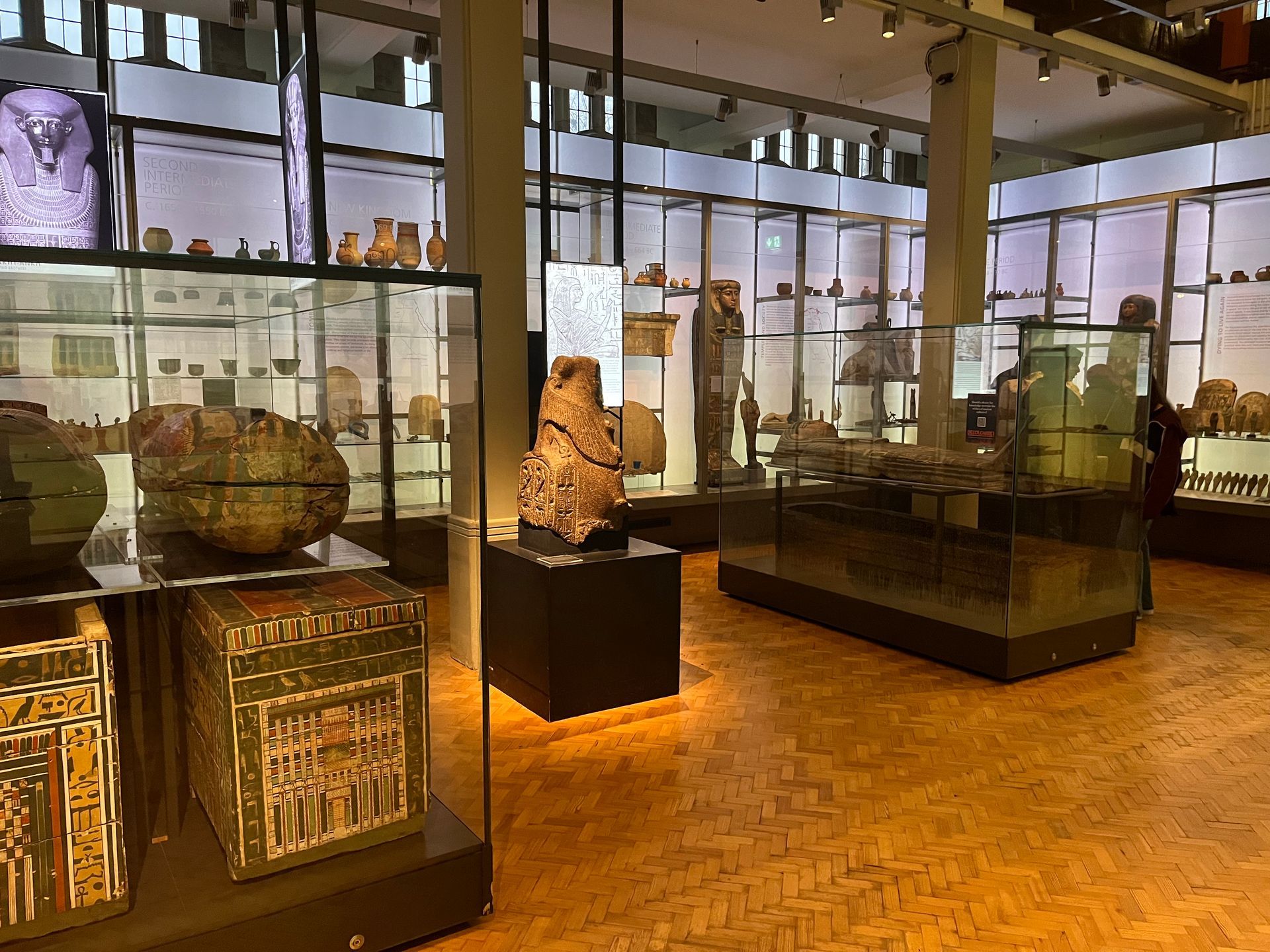
Photo: The National Museum of Egyptian Civilization, Cairo. Officially inaugurated in 2021.
More News